Emergency First Aid at Work Training
The Emergency First Aid Course can be adapted to suit a particular audience and is ideal for those who would like or need Appointed Person status. This is the statutory Health and Safety Executive (HSE) approved Emergency First Aid at Work course, in accordance with the Health and Safety (First Aid) Regulations 1981..
The one day course includes both theory and practical sessions within a relaxed atmosphere that is designed to promote confidence.
Subjects covered in the Emergency First Aid at Work Course include:

- First Aid Priorities
- Treatment of an unconscious Casualty
- Examining a Casualty
- Health and Safety (First Aid) Regulations
- Burns and Scalds
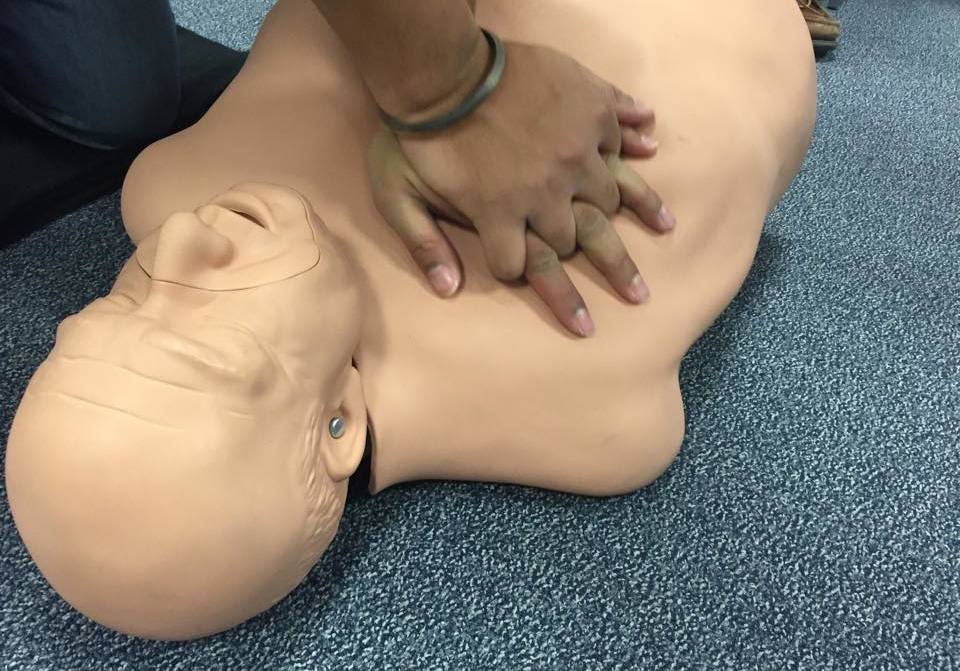
- Basic Life Support
- First Aid Kits
- Control of Bleeding
- Managing Incidents and Prioritising
- Recording and Reporting
Certification
Certification is dependent on successful continuous assessment of the student as there is no formal final examination. Those students who complete the course to the required standard are issued with a certificate that is valid for a period of three years.
*Under the current guidelines it is strongly recommended that first aid trained staff attend a half-day First Aid at Work Refresher every twelve months.
To book call 0800 505 3805
First Aid Skills
Some skills are thought to be extremely important to the provision of first aid and are taught ubiquitously. Particularly, the "ABC"s of first aid, which concentrate on critical life-saving intervention, must be given before the treatment of less serious conditions. ABC stands for Airway, Breathing, and Circulation. The same aide memoire is used by almost all emergency health professionals. Attention must first be shown to the airway to make sure it is clear. trouble (choking) is a life-threatening condition. Following checking of the airway, a first aider would ascertain adequacy of breathing and provide rescue breathing as appropriate. Taking the casualty's pulse is now not most often carried out for casualties who are not breathing normally, with first aid attendants now taught to go straight to chest compressions (consequentally giving artificial circulation) but checking of circulation may be done on less urgent patients. could be useful here.
Some companies add a fourth step of "D" for Deadly bleeding or Defibrillation, while others consider this as part of "C" for Circulation. Alternatives on methods to assess and nurture the ABCs rely on the competence of the first aid trained individual. Once the ABCs are secured, first aid trained persons can begin other treatments as required. Many organisations teach the same order of priority using the "3Bs": Breathing, Bleeding, and Bones (or "4Bs": Breathing, Bleeding, Brain, and Bones). While the ABCs and 3Bs are taught to be used sequentially, many circumstances might need two steps to be considered simultaneously. this may mean and the provision of both artificial ventilation and chest compressions to someone who is not breathing normally and has no pulse but also the consideration of cervical spine injuries when ensuring an open airway. They would need to ensure that were available.
Preserving life
In order to stay alive, all persons require to have an open airway - a clear route where air can pass through the mouth or nose via the pharynx and down into the lungs without difficulty. People who are conscious will preserve their own airway subconsciously, but those who are not responsive (with a GCS of less than 8) may be unable to support an adequate airway, due to the fact that the part of the brain which automatically controls and monitors breathing in normal circumstances might not be functioning correctly.
If the casualty was breathing normally, a first aid attendant would usually then place them in the recovery position, with the patient put over on their side, which also has the effect of clearing the tongue from the pharynx. It also halts a common cause of death in unconscious casualties, which is choking on vomit. may be used here to enable success.
The airway can also become blocked due to a foreign object getting wedged in the pharynx or larynx, commonly referred to as choking. The first aid trained person will be trained to deal with this by using a combination of back blows and abdominal thrusts.
Once the airway has been made clear, the first aid trained individual would gauge to see if the patient is breathing. If breathing is not present, or the casualty is not breathing normally, such as agonal gasps, the first aider would use what is likely the most recognised first aid procedure - CardioPulmonary Resuscitation or CPR, which means breathing into the casualty and manually compressing the chest which causes the heart to pump to promote blood flow around the casualty's circulatory system causing the brain to be oxygenated.
Promoting recovery
The first aid trained individual is also likely to be taught in dealing with injuries such as cuts, grazes or broken bones. They may be able to deal with the emergency completely (a small adhesive bandage on a paper cut), or might be required to maintain the condition of something like breaks, until the next phase of care (most usually an ambulance) arrives on the scene.
If are available it is always a good idea to employ them in some way. This may be beneficial for the patient.